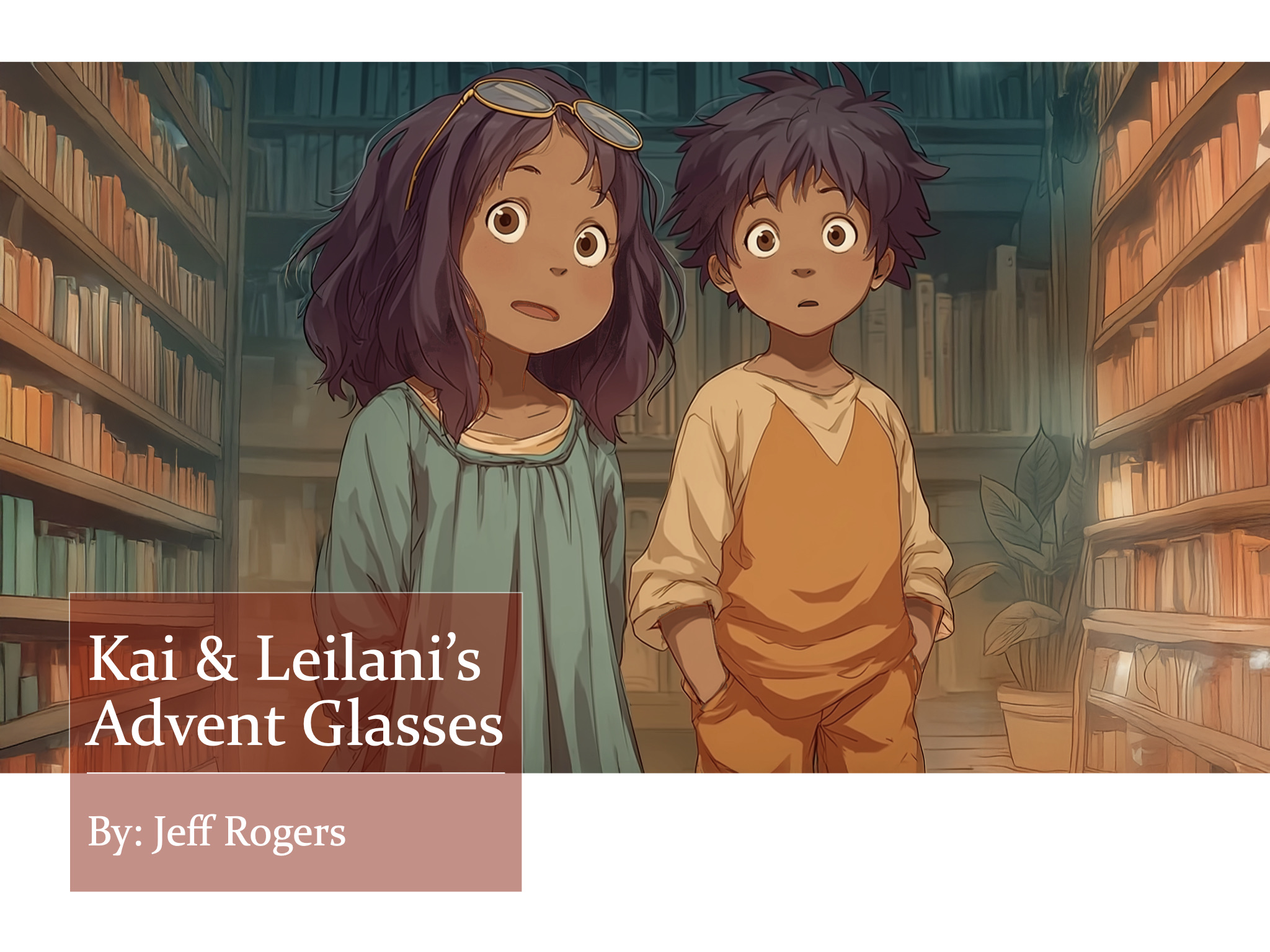
Read a new tale of time-travel and Christmas wonder from our church to your ohana! We are counting down to Christmas Eve with new chapters up daily on our FB.
Part One: The Hidden Book
Leilani had forgotten how very far Hawai’i was.
After five hours on the plane from Nevada, the brown desert gave way to endless blue ocean and then, finally, to a black lava rock coast with rich green forests atop Hawai’i Island. She felt like she was seeing color for the first time. Kai, next to her with headphones on, slept through the descent. He was only eight—two years younger than Leilani—and he always slept when he was nervous, though he would never admit to being nervous about anything.
They hadn’t been back to Hawaiʻi in three years. Three years since Tūtū had hugged them at this same airport, since they’d eaten poke from the cooler in the back of Uncle Manu’s truck, since they’d fallen asleep to the sound of coqui frogs instead of traffic. Their mother said the flights were too expensive. Their father said nothing, but Kai once overheard him on the phone with Tūtū, his voice tight: “I’m trying, Ma. I’m trying.”
Now they were back, and everything was the same and different all at once.
Tūtū’s house in Honaunau was smaller than Leilani remembered, but it smelled right—plumeria and rice and something frying in the kitchen. Cousins she barely recognized ran through the rooms. Aunties she couldn’t name kissed her cheeks and exclaimed over how tall she’d gotten. Kai stood in the corner of the living room, watching it all with the expression he wore when he was trying to figure out the rules of a new situation. Leilani went over and stood beside him. She didn’t say anything—just stood there so he wouldn’t be alone.
On the second day, Tūtū announced that she needed help at the church.
“The library,” she said, handing Kai a broom and Leilani a box of rags. “Nobody has cleaned it in months. Christmas Eve service is in five days, and I won’t have Kahu worry.”
The church was old and tall, with ohia posts and long wooden pews. The library was a single room upstairs, crowded with shelves and smelling of dust and aged paper. Kai swept halfheartedly. Leilani found herself drawn to the books—old hymnals, cracked Bibles, volumes with names she couldn’t pronounce.
“This is boring,” Kai said.
“This is beautiful,” Leilani said, at the same moment.
They looked at each other and almost smiled.
Leilani was reaching behind a bottom shelf, trying to retrieve a rag she’d dropped, when her fingers touched something wedged against the wall. A book—but heavier than it should have been, and somehow warmer. She pulled it out.
The cover was worn leather, the color of dark honey. There was no title on the spine. When she opened it, the pages were hollowed out, and nestled inside was a pair of bronze-rimmed glasses wrapped in faded cloth.
“Kai. Come look.”
He came, still holding the broom. Together they unwrapped the glasses. They were old—really old—with thin frames and round lenses that seemed to hold light differently than they should. Tucked beneath them was a slip of paper, the handwriting faded but still legible.
E nānā me ka manaʻoʻiʻo.
“What does that mean?” Kai asked.
Leilani’s Hawaiian was rusty—three years in Nevada worn it thin—but she remembered enough. “Look with faith. Or maybe… see with faith.”
Kai picked up the glasses, turning them over in his hands. “They’re probably just old reading glasses. Some kahu left them here a hundred years ago.”
“Then put them on.”
He looked at her. She looked back, steady and certain, the way she always was when she knew something he didn’t. Being the older cousin meant Leilani was usually right about things, and Kai learned to trust her—even when what she was suggesting seemed crazy.
Kai put on the glasses.
The library vanished.
One moment he was standing on the worn wooden floor, broom handle still in his grip. The next, the broom was gone, the floor was gone, and he was standing on hard-packed dirt in the bright sun, and the air smelled of dust and olive trees. A sky without skyscraper or signage.
Leilani was beside him. She looked as startled as he felt—wherever they had gone, she had come too. She gripped his arm hard enough to leave marks.
“Kai. Kai.“
He couldn’t speak. They were standing in the narrow street of a village—small clay houses, flat roofs, women carrying water jars on their heads.
“Where are we?” Leilani whispered.
At the end of the street a door was open, and light was pouring out of it—not sunlight, not firelight, but something else entirely. Something that made Kai’s chest ache without knowing why.
They moved toward it without a word.
Inside the house, a young woman stood frozen in the center of the room. She was young—older than Kai and Leilani, but not by much. Maybe sixteen, seventeen. She wore simple clothes, her dark hair covered, her hands raised as if to shield her face.
And before her stood something that was not a man.
It had the shape of a man—tall, dressed in white—but the light came from inside it, and its face was terrible and beautiful, and when it spoke, the words were in a language Kai had never heard and yet understood perfectly.
“Do not fear, Mary.”
The girl—Mary—trembled. Her whole body shook. But she did not run. She did not scream. She lowered her hands, slowly, and looked at the shining figure.
“You have found favor with God,” the angel said. “You will conceive and bear a son, and you will call his name Jesus. He will be great, and will be called the Son of the Most High.”
Leilani’s grip on Kai’s arm tightened. He could feel her shaking too. Or maybe he was the one shaking.
Mary’s voice, when she spoke, was barely a whisper. “How can this be?”
The angel answered. Kai heard the words—the Holy Spirit, the power of the Most High, nothing is impossible with God—but he was watching Mary’s face. He watched the fear in her eyes. He watched it change.
It did not disappear. That was the thing Kai would remember most. The fear did not go away. But something else came alongside it—something stronger. Her chin lifted. Her hands stopped trembling.
“I am the servant of the Lord,” Mary said. Her voice was steady now. “Let it be to me according to your word.”
The light blazed once, blinding, and then the angel was gone. Mary stood alone in the room, one hand pressed to her heart, breathing hard. She closed her eyes. A single tear slid down her cheek.
And then the room dissolved, and the dirt street dissolved, and Kai was standing in the church library with the glasses in his hands and Leilani beside him, and neither could speak.
They sat on the floor for a long time.
Finally, Leilani said: “That was real.”
Kai nodded. His hands were still shaking. He set the glasses down carefully, as if they might break—or as if they might take him somewhere again without warning.
“She was so scared,” he said.
“But she said yes.”
Kai thought about his father, working three jobs. His mother, learning to smile when there wasn’t enough money at the end of the month. He thought about the way they put him and Leilani on that plane even though the tickets cost more than a month of rent, because Tūtū was getting older and ohana matters more than fear.
“Brave ones can be afraid,” he said slowly. “But say ‘yes’ anyway.”
Leilani looked at him with surprise. Sometimes Kai said things that made her forget he was only eight.
“Tūtū says that,” she said.
“I know.”
They wrapped the glasses carefully and placed them back inside the hollowed book. Leilani slid it onto a shelf where they could find it again, behind a row of old hymnals.
“Tomorrow?” she asked.
Kai nodded. “Tomorrow.”
They finished cleaning the library in silence, but it was a different kind of silence than before—a wonder they wouldn’t whisper of. When Tūtū came to drive them home, she looked at their faces and raised one eyebrow but asked no questions.
That night, lying on a mat in the crowded living room, Kai stared at the ceiling and listened to his cousins breathing. Outside, the coqui frogs sang their endless two-note song.
She was so young, he thought. And she said yes.
He drifted asleep still thinking about it.

Part Two: The Full House
Kai had spent most of his eight years in Nevada, where the sky glowed orange at night and desert stretches flat and brown wherever he looked. Back home, their apartment had thin walls and a view of a parking structure, and their neighbors were simply strangers who nodded in the hallway.
Tūtū’s house in Honaunau was a different universe entirely. Here, cousins wandered in without knocking, uncles appeared at odd hours to “talk story” on the lānai. Leilani found it wonderful. Kai, if he was being honest, found it a little overwhelming—though he would not have said so for anything in the world.
It was their third day back when they crept into the church library again.
“You sure the glasses will work twice?” Kai asked. He was the sort of boy who needed things to follow rules, and magic, as far as he could tell, did not seem to have any.
“Only one way to find out,” said Leilani.
She picked up the glasses. “My turn.”
Kai nodded and stood close beside her. Leilani took a breath and slid them on.
The library was gone—or rather, they were gone from it—and the smell of old paper and koa wood was replaced by dust, musty animals and something cooking over a fire. Kai looked down at his hands, then at Leilani. She was still wearing the glasses, and somehow he had come with her.
They stood at the edge of a town unlike any place they had ever seen, and yet somehow felt strangely familiar.
“Bethlehem,” Leilani breathed.
The town was absolutely stuffed with people. Families poured through the streets—grandparents on donkeys, fathers carrying sleeping children, mothers balancing bundles on their heads and scolding older kids who ran too far ahead. Cooking fires sent up thin ribbons of smoke.
“It’s like Tūtū’s house,” Kai said slowly, “but a whole town of it.”
The Roman Emperor had ordered a census, and everyone in the land had to return to their ancestral home to be counted. Every family in Bethlehem had thrown open their doors to cousins and second-cousins and relatives they hadn’t seen in years. Every home was full to bursting.
The cousins followed Mary and Joseph through the crowded streets. They had spotted them coming in through the town gate—Joseph leading the donkey with one hand and holding Mary steady with the other. Mary looked exhausted. There was no other word for it. Her face was pale, her hands gripped the donkey’s mane, and every few moments she would close her eyes and breathe in a way that made Leilani’s stomach tighten with worry.
“She’s going to have the baby soon,” Leilani whispered.
Kai said nothing. He was watching Joseph—the way the man kept looking back at his wife, the way his jaw was set tight, the way he walked a little faster whenever Mary winced. Kai’s own father worked hard back in Nevada. He knew what it looked like when a man was scared but refusing to show it.
Joseph led them to a house on the eastern side of town and knocked.
The door opened, and what happened next was not at all what Kai had expected.
A woman’s face appeared—middle-aged, tired, but with bright eyes that went wide when she saw Joseph. “Yosef!” she cried, and then she was pulling him into an embrace, and then she saw Mary on the donkey, and her hands flew to her face.
“Oh—oh, the baby! Rivka! Shoshana! Come, come!”
More women appeared. There was a great commotion of embracing and exclaiming and helping Mary down from the donkey. Kai watched, startled. Where was the cruel innkeeper? Where was the door slammed in their faces?
“They know them,” he said.
“Family,” said Leilani. “They’re Joseph’s family.”
The cousins watched as Joseph was pulled inside, as Mary was surrounded by aunts and cousins who touched her belly and clucked with concern. But then Kai saw the problem.
The house was packed.
Through the open door, he could see bodies everywhere—children asleep on mats, old men talking in corners, a young mother nursing a baby by the fire. There were people on the stairs that led to the upper room. There were people in the courtyard.
The woman who had answered the door—she must have been Joseph’s aunt or cousin—was speaking rapidly, her face twisted with distress. Leilani moved closer to hear.
“The guest room is full, Joseph. Your uncle Matthias, his whole family—twelve of them. And old Ezra cannot climb stairs anymore, so he sleeps there too. I have nothing to offer but—” She hesitated. Her eyes darted to the lower level of the house, where the animals were kept.
Joseph looked at Mary. Mary looked back at him. Something passed between them—the kind of conversation that happens without words, the kind that Kai had seen between his own parents when money was tight and decisions had to be made.
“It will do,” Joseph said quietly. “It will be enough.”
The women of the house did not simply point Mary toward the stable, but led the way down.
Within minutes, the lower room was transformed. Fresh straw was spread over the floor. Blankets appeared—old but clean. One aunt brought a basin of water and cloths. Another brought broth in a clay cup and made Mary drink every drop. A young girl, no older than Leilani, came down with a small oil lamp and set it carefully so Mary would have light.
“It is not what you deserve,” the older woman said, touching Mary’s cheek. “But you will not be alone. We are here.”
Kai watched Joseph clasp hands with a man who must have been his cousin. Both men’s eyes were wet.
“I wish we had more,” the cousin said.
“You have given plenty,” Joseph replied.
The stable was a gift—imperfect, humble, but offered with everything the family had.
The animals shifted and snorted in their stalls. The lamp flickered. Mary lay back against the blankets, one hand on her belly, and closed her eyes. Somehow, in that crowded, warm, hay-scented darkness, there was peace.
The library came back slowly, like waking from a deep sleep.
Kai sat on the floor with his back against a bookshelf. Leilani was beside him, the glasses in her lap. Neither of them spoke for a long moment.
Finally, Kai said: “That’s how it is at Tūtū’s, yeah?”
Leilani nodded. She was thinking of last night—how Uncle Manu had given up his bed for their mom and slept on the lānai; how there were never enough chairs, so the kids sat on the floor and nobody minded.
“We give what we get,” Kai said. It was something their father always said, usually when he was handing their mom his whole paycheck and keeping nothing for himself.
Leilani pulled out the small notebook she had started keeping. She wrote carefully:
Sometimes love looks like making space where there isn’t any.
And then, underneath:
The stable wasn’t rejection. It was the best they had.
From somewhere in the church, they heard Tūtū’s voice calling. It was time for lunch—rice and kalua pork… and probably too many cousins already crowded around the table.
Kai stood and offered Leilani his hand. “You ready?”
She tucked the notebook into her pocket and smiled. “Yeah. Let’s go make space.”

Part Three: The Night of Nights
Christmas Eve arrived with rain.
It came down soft and warm, the kind of rain that fell almost every afternoon in Honaunau before the sun broke through again. Kai stood on the lānai and watched it turn the slopes impossibly green while, inside, the house erupted with preparation. Tūtū was in the kitchen, directing traffic like a general commanding troops.
“You two,” she said, catching Kai and Leilani trying to slip past, “go to the church early. Make sure the candles are set up for the service. And don’t get your good clothes dirty.”
They did not need to be told twice.
The church was quiet when they arrived, the pews empty, the altar decorated with ti leaves and white ginger. They worked quickly, setting out candles, adjusting hymnals. And then, without a word, they walked to the library.
The book was where they had left it.
Leilani lifted the glasses out. “It’s Christmas Eve.”
Kai understood what she meant. If the glasses had shown them the angel’s announcement, and then the journey to Bethlehem—
“Tonight,” he said. “It has to be tonight.”
Leilani held out the glasses. “Your turn.”
Kai took them. His hands trembled slightly as he raised them to his face. Leilani stepped close and put her hand on his shoulder. He slid the glasses on.
The library dissolved.
The stable was dark except for a single oil lamp.
Kai and Leilani stood just inside the doorway, pressed against the cool stone wall, barely breathing. The animals were silent now—the ox lying down in its stall, the donkey with its head low. The smell of hay and warmth wrapped around them like a blanket.
Mary was in the center of the room, lying on the straw. Joseph knelt beside her, holding her hand. And in Mary’s arms—
The baby was so small.
Leilani had seen her cousins born in Nevada. She’d visited them in the hospital with their red faces and tiny fists. But this was different. This baby was wrapped in strips of cloth, lying against Mary’s chest, and the lamplight caught his face, and he was so small, and yet—
And yet the whole room felt like it was holding its breath. Like the ground beneath knew the mana of what had happened.
Mary was weeping. Not sad tears—something else. Wonder, maybe. Joseph’s face was wet too, and his hands shook as he helped Mary shift the baby’s weight.
“He’s here,” Mary whispered. “He’s really here.”
Joseph touched the baby’s cheek with one rough finger. “Jesus.” He said the name like it was the most precious thing he’d ever spoken.
Kai felt something tighten in his chest. He thought of his own father—calloused hands, tired eyes, the way he said Kai’s name when he came home late from work and found him still awake. This was like that. A father meeting his son. Except—
Except this was also something else entirely.
A sound made them both turn.
Outside, in the darkness beyond the stable, something was happening. Voices—many voices—and footsteps, and a light that shouldn’t have been there at this hour.
Kai slipped through the doorway, Leilani right behind him. They crept along the wall of the house and looked out toward the hills beyond the town.
The sky was on fire.
Not fire—light. Light that moved and sang, light that had faces and wings, light that spoke with a voice like thunder and music combined. Kai’s knees buckled. Leilani grabbed his arm and held on, the way she always did when he needed steadying.
The angels filled the sky above a hillside where a group of men huddled together, their sheep scattering in terror. Shepherds. Kai could see their rough cloaks, their weathered faces lifted toward the impossible brightness.
“Fear not,” the light said. “For behold, I bring you good news of great joy that will be for all people. For unto you is born this day in the city of David a Savior, who is Christ the Lord.”
One of the shepherds—a young one, maybe twelve or thirteen—fell to his knees. His face was streaked with tears. The older men around him looked equally stunned, their mouths open, their hands raised as if to shield their eyes.
“And this will be a sign for you,” the angel continued. “You will find a baby wrapped in swaddling cloths and lying in a manger.”
And then the sky exploded with angels. Hundreds of them. Thousands. Their voices wove together in a sound that Kai felt in his bones:
“Glory to God in the highest, and on earth peace among those with whom he is pleased!”
The song echoed endlessly, but had lasted only a moment. The light faded. The angels were gone, and the shepherds stood alone on the dark hillside, breathing hard.
For a moment, no one moved.
Then the oldest shepherd spoke. “Bethlehem. Now. Run.“
Kai and Leilani followed them.
The shepherds ran through the streets of Bethlehem, asking at doors, waking families, until someone pointed them toward the house with the stable. They burst through the lower door and stopped.
Mary looked up. Joseph stepped forward, one hand raised as if to protect his family. But then he saw their faces—the wonder, the tears, the trembling—and something in his expression shifted.
“You head,” he said. “But now you may see.”
The oldest shepherd nodded. He couldn’t speak. He dropped to his knees before the manger where the baby lay, and the other shepherds followed, one by one, kneeling in the straw and the animal smell, their rough clothes and dirty faces pressed toward the ground.
Leilani watched Mary. The young mother’s eyes moved from face to face, taking in these strangers who had burst into her stable in the middle of the night. And then she smiled—a quiet, wondering smile—and gestured for them to come closer.
“His name is Jesus,” she said.
The shepherds wept.
Kai noticed the young shepherd hanging back. The boy stood near the doorway, his face twisted with something Kai recognized—the fear of not belonging, of being too young and too small to matter. His clothes were more ragged than the others. He was probably the one who got all the worst jobs.
Mary noticed him too. She looked past the older shepherds, straight at the boy, and held out her hand.
“Come,” she said. “Come and see.”
The boy’s face crumpled. He walked forward, slowly, and knelt closer than any of the others. Mary reached out and touched his head, gently, the way Tūtū touched Kai’s head when she was proud of him. The boy pressed his face into his hands and sobbed.
Kai had to look away. The moment was too sacred, too raw. He found Leilani’s hand and held on.
They told the shepherds first, he thought. Not the people in power. Not the rich ones. The shepherds.
The library came back with the sound of singing.
Voices from the sanctuary, drifting through the walls. The Christmas Eve service had started. Kai could hear Tūtū’s voice, strong and clear above the others: “Silent night, holy night…”
Leilani’s face was wet. She wiped her cheeks with her sleeve, but the tears kept coming.
“I understand now,” she whispered. “I understand what that song means.”
Kai nodded. He couldn’t trust his voice.
They put the glasses away and slipped out of the library, joining the congregation just as the song ended. Tūtū saw them and made space in the pew. She looked at their faces—red-eyed, stunned, transformed—and said nothing. She simply put an arm around each of them and pulled them close.
The candles flickered. Kahu David read the story from Luke—the same story, the same words. But now Kai heard it differently. He saw Mary’s exhausted face. He felt the young shepherd’s tears. He heard the angels’ triumphant chorus.

PART FOUR: The Light Was Enough
The day after Christmas was quiet.
The uncles had gone home. The aunties were sleeping late. Even Tūtū, who usually rose before dawn, was still in her room when Kai woke up. He lay on his futon and stared at the ceiling, listening to the morning birds, and thought about everything he had seen.
The angel in the lamplight. Mary’s exhausted smile. The baby in the manger. The shepherds falling to their knees.
Kai knew there was more. The glasses had shown them three pieces of the story, and it felt unfinished.
He found Leilani on the lānai, already awake, her notebook open on her lap.
“One more time,” she said. It wasn’t a question.
They walked to the church in the early morning light. The building was empty, still smelling of candles and plumeria from the night before. The library was cool and dim.
The glasses were waiting.
Leilani picked them up and turned them over in her hands. “We’ve each gone twice now,” she said. “You first, then me, then you again.”
“So it’s your turn.”
She nodded and slid them on. Kai put his hand on her arm.
The world shifted.
The world that formed around them was different this time.
The stable was gone. They stood in the doorway of a small house—mud walls, simple furniture, a cooking fire in the corner. Sunlight poured through a window. Time had passed. Months, maybe. The baby in the manger was now a child just beginning to walk, toddling across the floor with his hands outstretched while Mary watched, laughing.
“He’s bigger,” Leilani whispered.
Joseph sat in the corner, chiseling lightly on the edge of a rock with his hammer. His face was more relaxed than before—still watchful, but peaceful. This was a home. A family. An ordinary life, or something close to it.
And then the visitors arrived…
TO BE CONTINUED TOMORROW!


You must be logged in to post a comment.